

South London Sport: Charlton Athletic Edition is regularly catching up with Peter Varney, the club’s former chief executive and a boyhood fan of the club, to get his tales and inside info from when he was in a key position of responsibility in SE7.
In this ninth instalment, Varney reveals how he ended up working for the Addicks - after initially turning a job offer down.
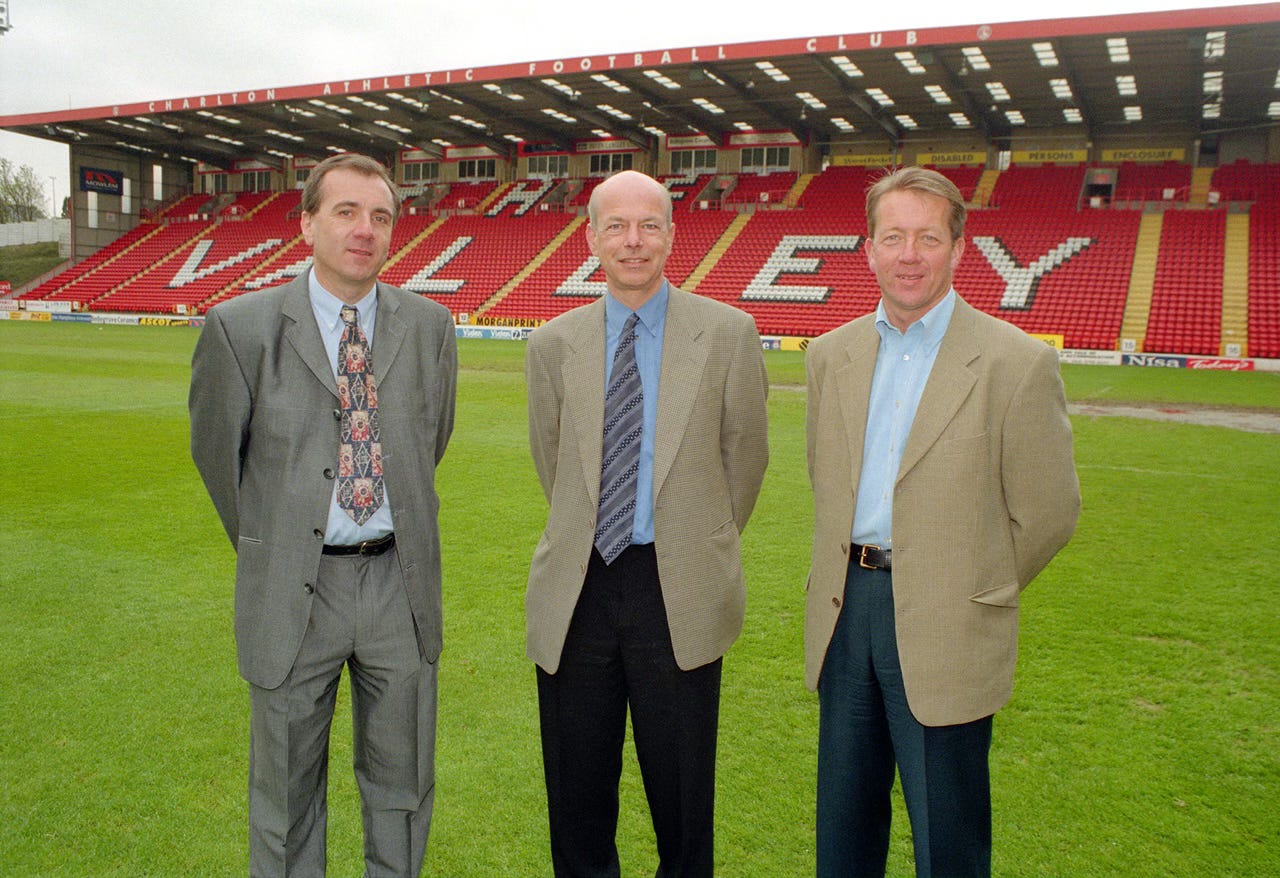
Peter Varney with Charlton chairman Richard Murray and manager Alan Curbishley in April 1998/Picture: Tom Morris
‘IT PUT A FEW PEOPLE’S NOSES OUT OF JOINT THAT I TOOK A POSITION WHERE THERE HAD NOT BEEN A FORMAL PROCESS’
Peter Varney spent more than 10 years at Charlton Athletic as their chief executive before he stepped down in June 2008. He later returned as a director for a short period in 2009 to oversee a £7m bond issue to save the club from administration and then was executive vice-chairman between 2010 and 2012. So how did he go from a supporter to a position of power in SE7? Here is the full story.
I had worked for the Sports Council when Mrs Thatcher was privatising everything. I was second in the team which was set up to privatise the five national sports centres - Bisham Abbey, Lilleshall, Holme Pierrepont, Plas y Brenin, the climbing place in Wales, and Crystal Palace.
The aim was to save £5million. I completed that and went to the CEO at Sport England and said: ‘What is the plan next?’
‘Well, because of the job you’ve done there we would like to put you in with the doping team.’ A woman called Michele Verroken used to run it, but I think she was coming to the end of her term.
That wasn’t something I felt was really me. Coincidentally at the time, I knew Stevie Gritt, who was Charlton’s joint manager with Alan Curbishley. His daughter Hayley got a brain tumour in October 1992. Steve said to me one day: ‘I’d like to do something for the British Brain & Spine Foundation. Would you come along and meet the neurosurgeon, Peter Hamlyn, who is behind the charity?’
Peter is one of the most inspirational people I’ve ever met. Our conversation quickly moved into ‘why don’t you come and do things around Steve Gritt? Do you want to do some events and raise some money under the Hayley Gritt Fund?’
It was very, very successful. Charlton didn’t have many active events programmes at that time. The Charlton fans got behind all this and we were raising significant sums of money.
Jumping back before that, to 1991, I had always been a big fan of Lennie Lawrence and when I heard he was getting a testimonial, I contacted Steve Sutherland, who was chairman of his testimonial committee, and said: ‘I think Lennie talks so much sense. I’d love to run a testimonial dinner for him.’
Steve raised it at a committee meeting and I got a phone call saying: ‘How many people do you think you would get to this dinner?’
I told them probably 500 or so. They dismissed me as the local lunatic (not Steve) and in any event Lennie left to become the manager of Middlesbrough in July 1991. So I then decided to organise it as a Back To The Valley dinner and that I’d give the proceeds to the club. I arranged to meet Roger Alwen and stumbled across his wife Heather, who was the receptionist at the time. Her exact words to me is that they would be happy to get that amount for a match-day function.
I told them if I didn’t manage to reach that number then I would think of another way of doing it.
‘You don’t want to be associated with it, because a failure won’t reflect well on the club.’
That was how it was left - it wasn’t going to be for the club at all.
